A controller does not move a car directly. It requests actuator behaviour, which changes wheel motion and tyre forces, which then changes the vehicle state. Feedback closes that chain.
That sequence matters because a requested steering angle is not an achieved steering angle, and an achieved angle is not a guaranteed lateral acceleration. Autonomous racing control must account for those distinctions while operating on a strict timing budget. Otherwise the controller can mistake a physical limit for an error that needs an even larger command.
Start where forces enter the car
The tyre contact patch is the interface through which most commanded motion reaches the ground. Longitudinal slip contributes to driving and braking force; slip angle contributes to lateral force. These relationships are nonlinear and change with load, temperature, wear and surface condition.
A bicycle model combines the left and right wheels at each axle into a simpler representation. It is valuable for reasoning and computation, especially when its assumptions are stated. It does not automatically capture individual wheel loading, every transient tyre effect or the behaviour of a car operating far beyond the model’s intended region.
The model should be selected for the decision it supports. More detail can improve representation while increasing identification effort and computation. A complicated model with poorly known parameters may be less useful than a simpler model with carefully measured limits and explicit uncertainty.
Connect references to feedback
A tracking controller typically compares the estimated vehicle state with a reference trajectory. Lateral position error, heading error, speed error and yaw response can all be relevant. Their coordinate definitions must agree with the planner, particularly near a path discontinuity or a trajectory replacement.
Feedforward anticipates the command suggested by the reference and the model. Feedback corrects the difference between expected and observed motion. Either can fail if the state estimate is delayed. A controller reacting to an old yaw rate may apply a correction after the vehicle has already moved past the condition that motivated it.
PID control, linear-quadratic regulation and model predictive control offer different trade-offs in implementation, constraint handling and modelling needs. Their names do not establish suitability. The important evidence is how a chosen implementation behaves across the intended envelope, including its transitions into limited operation.
Measure the actuator, not just the algorithm
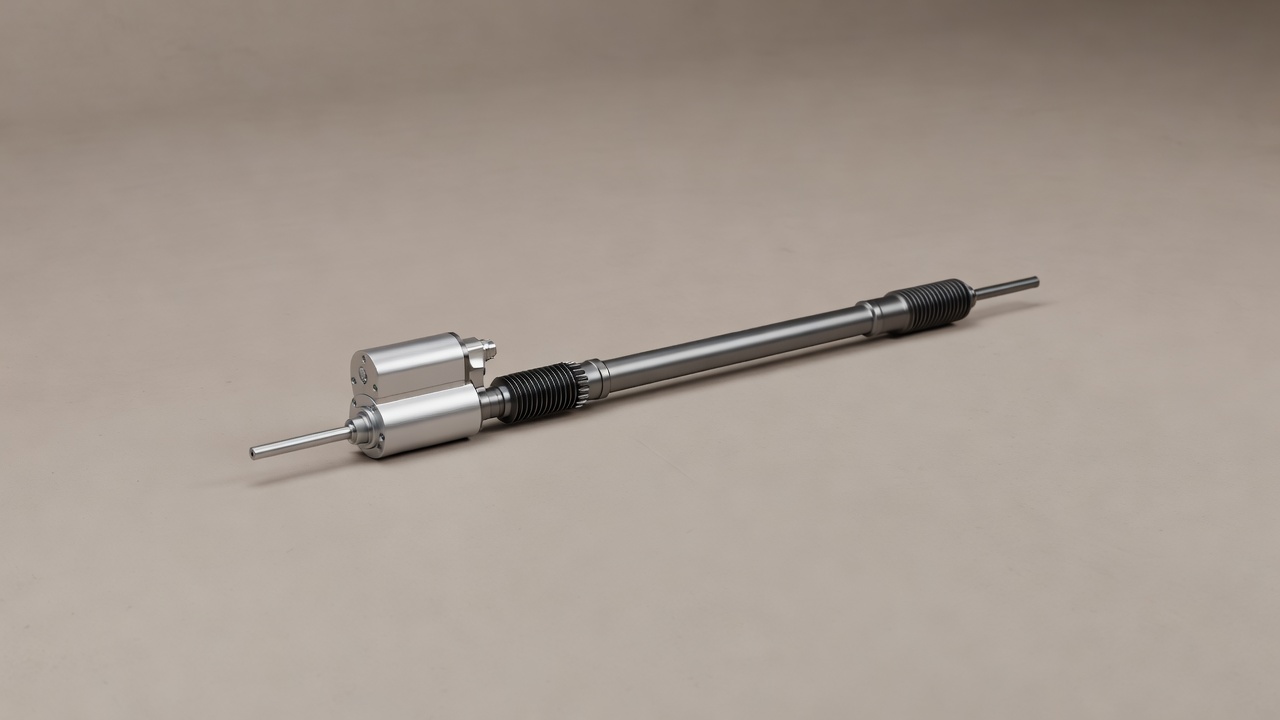
A steering system has angle limits, rate limits, backlash, compliance and a response delay. Braking may involve pressure dynamics and different behaviour during application and release. Electric power delivery can be restricted by thermal limits, battery state or inverter protection.
These properties should be identified through controlled measurement rather than hidden inside a tuning exercise. Commanded and measured values need to be logged on a common time basis. The resulting response can reveal whether a tracking problem originates in the controller, the actuator, the estimator or an incorrect assumption about the vehicle.
When an integrator continues accumulating error during saturation, it can cause an excessive response after authority returns. Anti-windup methods address this mechanism. They are not a substitute for ensuring that the planned manoeuvre is physically achievable, but they can prevent one limitation from producing a second avoidable transient.
Coordinate braking and turning
Longitudinal and lateral control cannot be treated as completely independent at the limits. A speed controller demanding strong braking may reduce the lateral force available to a steering controller. If the two loops are unaware of each other, both can respond to the resulting errors by asking for more than the tyres can supply.
A coordinated design shares relevant constraints and monitors whether actual motion remains consistent with them. It may reduce speed demand, change force allocation or request a new trajectory. What matters is that responsibility for the conflict is explicit rather than emerging accidentally from two competing loops.
Control quality is not the absence of error. It is a bounded, intelligible response when error appears.
Make supervision a separate question
The controller that pursues a trajectory should not be the only mechanism assessing whether pursuit remains acceptable. A supervisory layer can monitor stale references, excessive tracking error, actuator disagreement and health signals. Its authority, independence and failure response need to be designed, not assumed from a separate process name.
A controlled stop also requires usable steering and braking authority. “Stop” is a desired outcome, not a magical state that software can always impose. The safety concept must consider which failures leave that outcome reachable and what additional measures are required when it is not.
ISO 26262 provides a road-vehicle functional-safety framework, and ISO 21448 addresses safety of the intended functionality in its stated scope. They are useful reference points, not automatic certifications for a racing installation. Competition requirements and a vehicle-specific hazard analysis remain necessary.
The control loop finally returns to perception: measured motion either supports the model or exposes its limitations. Validation must now determine whether that entire cycle behaves acceptably, rather than judging each component only in isolation.